Table of Contents
ToggleHEPA 13 vs HEPA 14 filter: differences, efficiency & uses
Written by Neeraj Goel, Founder, Best Air Filter. 10+ years of experience manufacturing HVAC and industrial air filters in Delhi.
If you’re shopping for an air purifier, a vacuum, or an HVAC air filter, you’ve probably seen two labels that look almost the same: HEPA 13 and HEPA 14. The HEPA 13 vs HEPA 14 filter question comes up constantly, and the numbers seem small. The price difference isn’t.
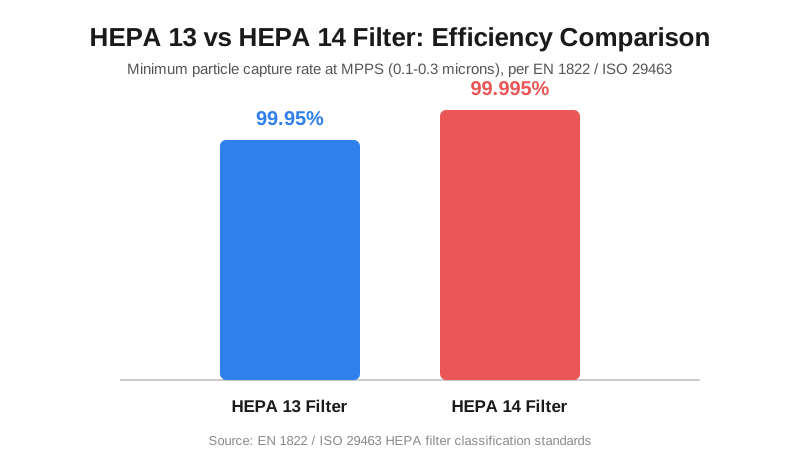
Here’s the short answer. HEPA 13 filters capture at least 99.95% of particles at their hardest-to-catch size. HEPA 14 filters capture at least 99.995%. That’s a tenfold jump in leftover particles, not a rounding error. But that extra performance comes with tradeoffs in airflow, noise, and cost that matter more for most homes than the spec sheet suggests.
This guide breaks down exactly what separates the two, where each one makes sense, and how to pick the right one without overpaying for filtration you don’t need. At Best Air Filter, we manufacture both grades for HVAC and industrial use, so this comparison is based on what we actually see on the production floor, not just spec sheets.
HEPA 13 vs HEPA 14 filter: quick comparison table
| Factor | HEPA 13 | HEPA 14 |
|---|---|---|
| Minimum efficiency | 99.95% at MPPS | 99.995% at MPPS |
| Particle size tested | Down to 0.1–0.3 microns | Down to 0.1–0.3 microns |
| Standard | EN 1822 / ISO 29463 | EN 1822 / ISO 29463 |
| Airflow impact | Lower resistance, better airflow | Higher resistance, reduced airflow |
| Noise level | Lower | Higher (fan works harder) |
| Typical cost | Lower | 20–40% higher, often more |
| Best for | Homes, offices, schools, allergy relief | Hospitals, labs, cleanrooms, high-risk cases |
| Residential availability | Common | Rare, only a handful of models |
What HEPA ratings actually mean
HEPA stands for High Efficiency Particulate Air. It’s not a brand. It’s a performance standard that describes how much of the air passing through a filter actually gets cleaned.
In Europe and most of the world, HEPA grades are set by EN 1822 and ISO 29463. Filters are tested at their Most Penetrating Particle Size, or MPPS, usually somewhere between 0.1 and 0.3 microns. That’s the size range where particles are hardest to trap, so testing at MPPS gives a worst-case efficiency number rather than a best-case one.
This matters because the United States uses a different standard. The US Department of Energy defines “True HEPA” as capturing 99.97% of particles at 0.3 microns specifically, not at MPPS. Some brands blend these two systems in their marketing, which is why you’ll see confusing claims online. A product labeled “True HEPA” in the US isn’t automatically the same as an H13 or H14 filter tested under EN 1822. If a listing uses both terms, check which standard the number is actually tied to before comparing products.
Filter grades run from H10 up through H14, with U15 and higher classified as ULPA (Ultra Low Penetration Air) filters. H13 and H14 sit at the top of the HEPA range, just below ULPA, which is exactly why the HEPA 13 vs HEPA 14 filter comparison matters more than comparing lower grades like H11 or H12.
HEPA 13 explained
HEPA 13 filters remove at least 99.95% of airborne particles at MPPS. In practical terms, that means dust, pollen, mold spores, pet dander, and most bacteria get caught before they recirculate through your room.
H13 is the filter grade most residential air purifiers use when they claim “medical grade” or “hospital grade” filtration. It’s also common in hospital patient rooms, offices, schools, and general-use cleanrooms where strict sterility isn’t required. If you’re comparing options, our HEPA 13 filter range covers most of these use cases.
The fiber structure in an H13 filter is dense enough to trap fine particles but still loose enough to let air pass through without heavily restricting the fan. That balance is why H13 remains the default choice for most consumer air purifiers on the market.
HEPA 14 explained
HEPA 14 filters remove at least 99.995% of particles at MPPS. That’s roughly 10 times fewer particles slipping through compared to H13, at the same tested particle size.
To hit that efficiency, H14 filters use a denser fiber weave. More fiber means more surface area to trap particles, but it also means more resistance to airflow. A fan has to work harder to pull air through an H14 filter, which raises noise and can shorten motor lifespan if the purifier wasn’t designed for it.
H14 is standard in operating theaters, pharmaceutical manufacturing, semiconductor cleanrooms, and nuclear facility ventilation, environments where even a small particle leak carries real consequences. In residential use, H14 is far less common. As of now, only a small number of manufacturers sell home air purifiers with a true H14 filter, and they tend to need larger, more powerful motors to push air through the denser media without losing performance. We supply HEPA 14 filters mainly for these industrial and cleanroom applications rather than residential units.
HEPA 13 vs HEPA 14 filter: key differences side by side
Efficiency. H13 captures 99.95% of particles at MPPS. H14 captures 99.995%. The gap looks tiny as a percentage, but it represents a tenfold reduction in particles that escape filtration.
Airflow. H13’s looser fiber structure lets air move through with less resistance. H14’s tighter weave restricts airflow more, which is why H14 purifiers often need bigger fans to maintain the same air changes per hour.
Noise. More airflow resistance means the fan motor has to work harder, and harder-working fans are louder. If you’re sensitive to noise, especially for a bedroom unit, H13 is usually the more livable choice.
Cost. H14 filters cost more to manufacture because of the denser fiber and tighter manufacturing tolerances. Expect to pay noticeably more both for the initial unit and for replacement filters over time.
Filter lifespan and maintenance. Denser filters can clog faster under heavy particle loads, which sometimes means more frequent replacements despite the higher upfront cost. Over a year or two, that adds up.
Availability. H13 purifiers are widely available across dozens of brands and price points. H14 residential units are a small, specialized category, often limited to one or two models per manufacturer. For industrial and HVAC buyers, our industrial air filters page lists current stock across both grades.
HEPA 13 vs HEPA 14 filter: which one should you choose
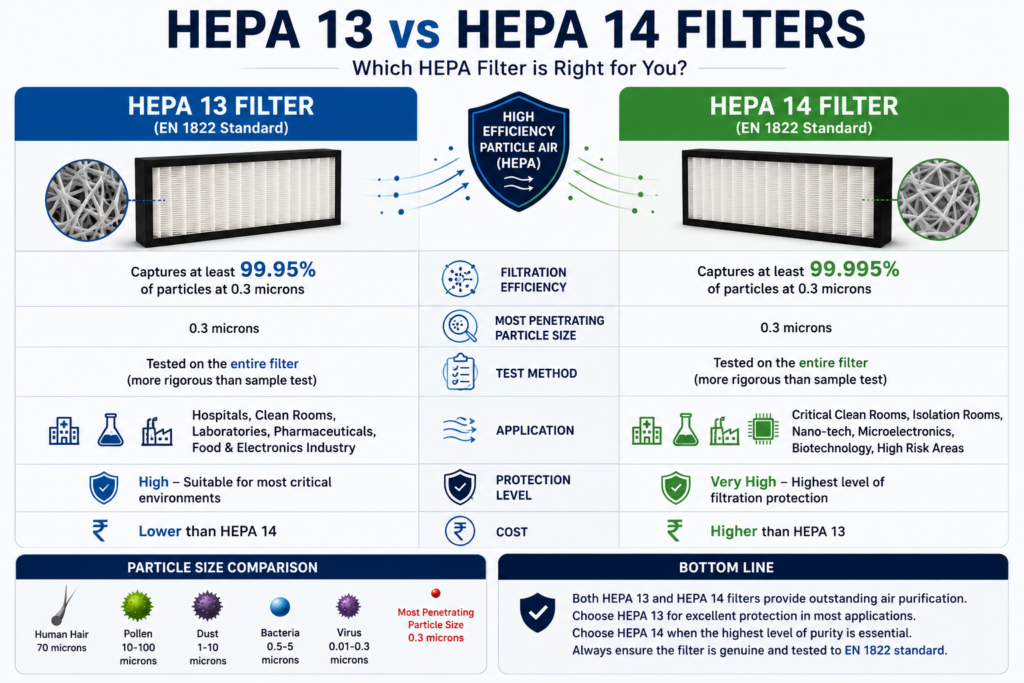
Once you understand the HEPA 13 vs HEPA 14 filter difference in numbers, the real decision comes down to what you’re actually filtering for, not which number sounds more impressive.
Choose HEPA 13 if:
- You’re filtering a home, apartment, office, or classroom
- You deal with allergies, pet dander, dust, or general indoor air quality
- You want lower noise and better airflow for continuous use
- You want to avoid paying for filtration capacity you won’t notice day to day
Choose HEPA 14 if:
- You or someone in your household is immunocompromised or has a severe respiratory condition
- You’re setting up a lab, cleanroom, or medical-adjacent space
- You live somewhere with extreme, sustained air pollution or heavy wildfire smoke exposure and want the maximum available filtration
- Cost and noise are secondary to filtration performance
For the overwhelming majority of households, HEPA 13 delivers filtration that’s already well beyond what’s needed to noticeably improve air quality. The jump to HEPA 14 makes sense in specific, higher-stakes situations, not as a default upgrade. If you’re unsure which grade fits your space, you can ask our filtration team for a recommendation based on room size and use case.
Which one should you choose
The right choice depends on what you’re actually filtering for, not which number sounds more impressive.
Choose HEPA 13 if:
- You’re filtering a home, apartment, office, or classroom
- You deal with allergies, pet dander, dust, or general indoor air quality
- You want lower noise and better airflow for continuous use
- You want to avoid paying for filtration capacity you won’t notice day to day
Choose HEPA 14 if:
- You or someone in your household is immunocompromised or has a severe respiratory condition
- You’re setting up a lab, cleanroom, or medical-adjacent space
- You live somewhere with extreme, sustained air pollution or heavy wildfire smoke exposure and want the maximum available filtration
- Cost and noise are secondary to filtration performance
For the overwhelming majority of households, HEPA 13 delivers filtration that’s already well beyond what’s needed to noticeably improve air quality. The jump to HEPA 14 makes sense in specific, higher-stakes situations, not as a default upgrade. If you’re unsure which grade fits your space, you can ask our filtration team for a recommendation based on room size and use case.
Common myths about the HEPA 13 vs HEPA 14 filter comparison
Myth: HEPA 14 is always better. Better on paper, not always better in practice. If the extra resistance means your purifier runs quieter settings less often because it’s louder at full power, you can end up with worse real-world air turnover than a well-run H13 unit.
Myth: True HEPA and H13/H14 mean the same thing. They come from different standards, tested differently. Don’t assume a “True HEPA” label guarantees H13 or H14 performance unless the listing specifies the EN 1822 rating directly.
Myth: A higher HEPA number always means a bigger filter. Grade and physical size are separate specs. A compact H14 filter and a large H13 filter are both possible. Check the filter’s actual dimensions and your purifier’s rated coverage area separately from the HEPA grade.
Myth: You need H14 if anyone in the house has allergies. Most seasonal and pet allergies respond well to H13 filtration. H14 becomes relevant for specific medical situations, not general allergy management.
A note on trust and sourcing
Air purifier marketing is full of inflated claims, and HEPA grades are one of the most commonly misused specs in the industry. When you’re comparing products, look for listings that cite the actual EN 1822 or ISO 29463 test standard, not just a marketing label. Independent lab certifications and clear spec sheets are a stronger signal than adjectives like “medical grade” on their own.
This lines up with how Google evaluates content quality more broadly. Their guidance on creating helpful, reliable, people-first content asks a simple question: does this page give people the information they need to make a decision, backed by real expertise, rather than existing mainly to rank for a keyword. For a topic like filter grades, that means citing the standards bodies directly, being upfront about tradeoffs, and not steering every reader toward the more expensive option just because it sounds superior.
HEPA 13 vs HEPA 14 filter: frequently asked questions
Is HEPA 14 better than HEPA 13?
HEPA 14 filters more particles at the same tested size, so it’s technically more efficient. Whether it’s “better” for you depends on your airflow, noise, and budget priorities, not just the raw efficiency number.
Is HEPA 14 worth it for home use?
For most homes, no. HEPA 13 already removes the vast majority of allergens, dust, and airborne particles that affect everyday air quality. HEPA 14 is worth the tradeoffs mainly in medical, lab, or extreme air-quality situations.
What does H13 mean on an air purifier?
It means the filter is certified under EN 1822 or ISO 29463 to capture at least 99.95% of particles at its most penetrating particle size, typically between 0.1 and 0.3 microns.
Can I replace an H13 filter with an H14 filter in the same purifier?
Only if the manufacturer confirms the unit’s motor and housing support it. Denser H14 media can overload a fan that wasn’t designed for the added resistance, reducing both airflow and motor lifespan.
Does a higher HEPA number mean better odor removal?
No. HEPA filters trap particles, not gases or odors. Odor control comes from a separate activated carbon layer, regardless of whether the particulate filter is rated H13 or H14.
Are HEPA 13 and “True HEPA” the same thing?
Not necessarily. “True HEPA” usually refers to the US DOE standard tested at 0.3 microns, while H13 refers to the EN 1822 standard tested at MPPS. The numbers can look similar but come from different testing methods, so check which standard a product actually references.
HEPA 13 vs HEPA 14 filter: the bottom line
The HEPA 13 vs HEPA 14 filter debate comes down to this: both sit at the high end of particulate filtration, and the difference between them is real but narrow, 99.95% versus 99.995% efficiency, with H14 asking for more in airflow resistance, noise, and price in return.
For everyday home use, allergy relief, and general air quality, HEPA 13 gives you nearly all the practical benefit at a fraction of the cost and noise. Save HEPA 14 for situations where the stakes are genuinely higher, medical settings, labs, or extreme pollution exposure, where the extra filtration is worth what you give up to get it.
Browse our full range of HEPA and HVAC filters to compare specifications, or reach out for a custom filtration recommendation.