Table of Contents
ToggleBest HEPA 14 Filter | 99.97% Efficiency, All Sizes – India
Written by Neeraj Goel, Founder, 10+ years of experience manufacturing HEPA, bag, and industrial filters at hepafilter.in.
If you run a pharma unit, hospital, cleanroom, or HVAC contracting business, you have probably searched for a HEPA 14 filter and found more confusion than answers. Efficiency ratings, sizes, prices, replacement cycles: the terms get mixed up fast.
This guide covers what a HEPA 14 filter is, how it differs from HEPA 13, what sizes are available, how much it costs in India, and how to pick the right one for your setup.
What is a HEPA 14 filter
HEPA stands for High Efficiency Particulate Air. The number after HEPA tells you the efficiency class under the EN 1822 standard, the European testing framework most Indian manufacturers reference for HEPA and ULPA classification.
A HEPA 14 filter removes 99.995% of particles at 0.3 microns. That is the most efficient grade used in commercial and industrial filtration. For comparison, a HEPA 13 filter removes 99.95% of particles at the same particle size.
The 0.045% difference sounds small on paper. In a hospital operating theatre or a pharma cleanroom, it decides whether the air meets ISO 14644 cleanroom classification or falls short of it.
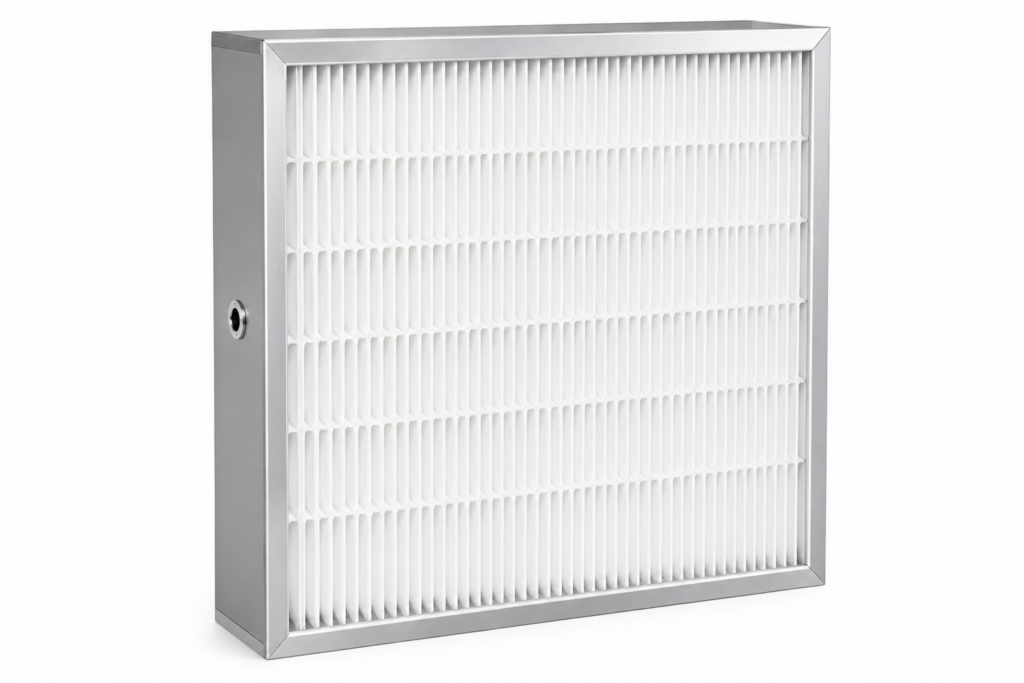
HEPA 14 filters use pleated glass fiber media packed into a rigid frame. The pleats increase surface area, which lets air pass through without dropping the filter’s efficiency.
HEPA 14 vs HEPA 13: the real difference
This is one of the most searched comparisons, so here are the numbers side by side.
HEPA 13
- Removes 99.95% of particles at 0.3 microns
- Used in general cleanrooms, HVAC systems, and standard hospital wards
- Lower cost, lower pressure drop
- Common in commercial air purifiers
HEPA 14
- Removes 99.995% of particles at 0.3 microns
- Used in operating theatres, pharma manufacturing, biosafety labs, and ISO Class 5 to Class 7 cleanrooms
- Higher cost due to denser media and stricter testing
- Required where regulatory compliance demands the highest filtration grade
Choose HEPA 13 for general air quality control. Choose HEPA 14 when your facility has a compliance requirement, a regulatory audit, or a process that cannot tolerate airborne contamination. Pharma manufacturing units and hospital OTs fall in this second group.
HEPA filter sizes: what's actually available
Size is where most buyers get stuck, because HEPA filters are not sold in one universal dimension. The right size depends on your housing, AHU (air handling unit), or duct opening.
Standard HEPA filter formats:
- Mini-pleat panel filters: common sizes are 610 x 610 mm, 305 x 610 mm, and 305 x 305 mm, with depths ranging from 66 mm to 292 mm. Used in AHUs and terminal HEPA boxes.
- Box-type HEPA filters: built with a gel seal or knife-edge frame for terminal application in operating theatres and cleanrooms. Sizes are usually specified by the ceiling diffuser or terminal box opening, not a fixed standard.
- Mini pleat cartridge filters: used in smaller AHU units, typical sizes range from 305 x 305 mm to 610 x 305 mm.
Here’s the part most suppliers don’t mention upfront: HEPA filters are rarely a true off-the-shelf product. Housing dimensions vary between AHU brands, building age, and duct design. A filter that fits a 2015 AHU installation may not fit a 2023 one from a different manufacturer.
This is why custom-cut HEPA 14 filters matter more than standard sizes for most Indian facilities. Send your housing dimension, and a manufacturer cuts the filter to match, rather than forcing your duct to match a catalog size.
A HEPA 14 filter also lasts longer when a pre-filter sits ahead of it in the AHU. The pre-filter catches larger dust particles first, so the HEPA stage isn’t doing that work and clogging faster than it should.
How to choose the right HEPA 14 filter size
Four things decide the correct size and spec:
1. Housing or duct dimension Measure the internal frame opening, not the outer casing. A few millimeters of mismatch causes air bypass, which defeats the purpose of installing a HEPA 14 filter in the first place.
2. Airflow requirement (CFM or m³/hr) Higher airflow needs more filter media surface area, which means deeper pleats or a larger panel. Undersized filters increase pressure drop and shorten fan life.
3. Application type Operating theatres and pharma fill-finish areas need gel-seal box filters for a leak-proof terminal fit. General AHU pre-filtration can use standard mini-pleat panels.
4. Certification needs If your facility undergoes ISO 14644 or GMP audits, ask for filters tested and certified at H13/H14 efficiency with a factory test report, not just a label claim.
For AHU systems with heavy dust load, a bag filter stage ahead of the HEPA 14 filter cuts the particulate load further, which extends the HEPA filter’s service life in factories and industrial HVAC setups.
If you’re not sure which spec applies to your setup, share your housing dimension and application with a manufacturer directly. A quick WhatsApp message with a photo of the housing or the AHU nameplate usually gets a size confirmed within the day.
HEPA 14 filter price in India
Price depends on size, media type, frame material, and certification level, so a single number rarely tells the full story. As a general range for the Indian market in 2026:
- Standard mini-pleat panel HEPA 14 filters: roughly ₹2,500 to ₹8,000 per unit, depending on size and depth
- Box-type gel-seal HEPA 14 filters for OT and cleanroom terminals: roughly ₹6,000 to ₹18,000 per unit, depending on dimensions and frame
- Custom OEM sizes: priced on drawing or sample, since dimensions and media grade change the cost directly
Bulk orders change the math. Facilities ordering 50 or more units typically get slab-based factory pricing, which brings the per-unit cost down 10 to 20% compared to single-unit purchase. If you’re buying for multiple AHUs or a hospital-wide upgrade, always ask for a bulk quote before ordering individually.
Buying direct from a manufacturer instead of a trading company also removes a markup layer. A factory that manufactures and tests in-house, rather than importing and relabeling, can usually quote lower for the same H13/H14 spec.
HEPA 14 filter replacement: when and how
HEPA 14 filters don’t have a fixed expiry date. Replacement depends on usage hours, particulate load, and pressure drop readings, not a calendar date alone.
Signs it’s time to replace:
- Pressure drop across the filter exceeds the manufacturer’s recommended final resistance (usually specified on the filter label or datasheet)
- Visible discoloration or physical damage to the pleat pack
- A drop in cleanroom particle count results during routine monitoring
- Airflow reduction noticed at diffusers or terminal outlets
Typical replacement cycles (as a starting reference, not a fixed rule):
- Pre-filters ahead of HEPA stages: every 3 to 6 months
- HEPA 14 filters in general AHU service: 12 to 24 months
- HEPA 14 filters in high-load pharma or OT applications: 6 to 12 months, based on differential pressure readings
Replacing a HEPA 14 filter without checking the housing dimension first is a common mistake. Filters degrade in efficiency if the frame doesn’t seal tightly against the housing gasket, even if the media itself is rated correctly. Always match the replacement filter’s exact frame size and depth to the original, or have it custom-cut to the current housing.
An Annual Maintenance Contract (AMC) removes the guesswork. Under an AMC, a supplier tracks your filter’s service hours and schedules replacement before pressure drop crosses the threshold, rather than waiting for a failure to show up in a compliance audit.
HEPA 14 filter for AC and HVAC systems
Home and commercial AC units rarely use true HEPA 14 filters, because standard split AC and window units aren’t built to handle the airflow resistance a HEPA 14 media creates. Most residential air purifiers use HEPA 13, or a “HEPA-type” filter that doesn’t meet either certified standard.
HEPA 14 filters fit properly in:
- Ducted HVAC systems with AHUs designed for higher static pressure
- Commercial and industrial air handling units in factories, hospitals, and pharma plants
- Dedicated cleanroom air supply systems
If someone tells you a HEPA 14 filter fits into a standard window AC unit, check the fan’s static pressure rating first. Most residential units aren’t built for it, and forcing a HEPA 14 filter into that airflow path reduces cooling performance instead of improving air quality.
For commercial buildings and HVAC contractors upgrading duct filtration, HEPA 14 filters install at the terminal end of the AHU, right before the diffuser, to protect the final air quality before it reaches the room.
Best air purifier with HEPA 14 filter: what to check
Several consumer air purifier brands, including Philips, market HEPA-based filtration in their room purifiers. Before buying based on a HEPA 14 claim alone, check three things:
- Certification proof: ask if the filter is tested to EN 1822 H14 standard with a factory test report, not just marketed as “HEPA 14 grade.”
- CADR rating: Clean Air Delivery Rate tells you how much filtered air the unit actually moves per hour, which matters more than the filter grade alone for room-level air quality.
- Filter replacement cost and availability: a HEPA 14 cartridge that’s hard to source or expensive to replace ends up unused after the first cycle.
For industrial and commercial use, most facilities don’t buy a consumer air purifier. They install HEPA 14 filters directly into their AHU or duct system, sized to the actual space, which gives more control over airflow and coverage than a standalone purifier unit.
Why buy direct from a HEPA filter manufacturer
Buying from a manufacturer instead of a distributor or trading company changes three things: price, lead time, and accountability.
Factory pricing. No trading margin sits between the quote and the production cost. On a 500-unit hospital order, that difference adds up fast.
Custom sizing. A manufacturer can cut to your exact housing dimension, rather than asking you to adjust your installation to a catalog size.
Direct accountability. If a filter fails a test or arrives with a size mismatch, you’re dealing with the people who made it, not a reseller who has to check with the factory first.
A supplier with 10+ years in business, ISO certification, and a track record with 500+ industrial clients across pharma, hospitals, and manufacturing plants has already solved the sizing and certification problems most first-time buyers run into. Look for a minimum order quantity (MOQ) that fits your scale (10 units is reasonable for smaller facilities), a dispatch time of 3 to 5 working days, and bulk pricing that kicks in around 50+ units.
Frequently asked questions
What is the difference between HEPA 13 and HEPA 14 filters?
HEPA 13 removes 99.95% of particles at 0.3 microns. HEPA 14 removes 99.995%. HEPA 14 is used where regulatory compliance or cleanroom classification demands the higher grade, such as pharma manufacturing and hospital OTs.
What sizes do HEPA filters come in?
Standard mini-pleat panels come in sizes like 610 x 610 mm and 305 x 610 mm, with depths from 66 mm to 292 mm. Box-type filters are usually sized to match the terminal housing or ceiling diffuser opening, which varies by installation.
Can I get a custom size HEPA 14 filter?
Yes. Share the housing dimension, a CAD drawing, or an existing sample, and a manufacturer can cut a filter to match, including private-label OEM orders.
What is the MOQ for ordering HEPA 14 filters?
A standard MOQ of 10 units per filter type lets smaller facilities and contractors order without carrying large stock. Bulk discounts typically apply from 50+ units.
How often should a HEPA 14 filter be replaced?
Replacement depends on pressure drop readings and usage hours, not a fixed calendar. General AHU service typically needs replacement every 12 to 24 months, while high-load pharma or OT applications may need it every 6 to 12 months.
Is a HEPA 14 filter suitable for home AC units?
Most residential AC and purifier units aren’t built for the airflow resistance of a true HEPA 14 filter. HEPA 14 filters are designed for ducted commercial and industrial HVAC systems with higher static pressure capacity.
Get the right HEPA 14 filter for your facility
Whether you need a standard mini-pleat panel or a custom-cut HEPA 14 filter for an OT terminal, the size and spec have to match your housing before efficiency numbers matter at all.
Share your housing dimension, application, and required quantity on WhatsApp, and get a factory quote with free technical guidance on which filter type fits your setup.
[Chat on WhatsApp: +91 96255 55709]
For more guides on filter selection, sizing, and maintenance, visit our blog.