Table of Contents
ToggleHEPA 13 Filter Manufacturer in India | 10+ Years Experience
Written by Neeraj Goel, Founder, 10+ years of experience manufacturing HEPA, bag, and industrial filters at hepafilter.in.
A HEPA 13 filter removes 99.95% of airborne particles at 0.3 microns. That single number decides whether a hospital operation theatre stays sterile, whether a pharma cleanroom passes audit, and whether an HVAC system actually protects the people breathing through it.
This guide covers what HEPA 13 means, how it compares to other grades, what it costs in India, and how to pick a manufacturer you can trust.
What is a HEPA 13 filter?
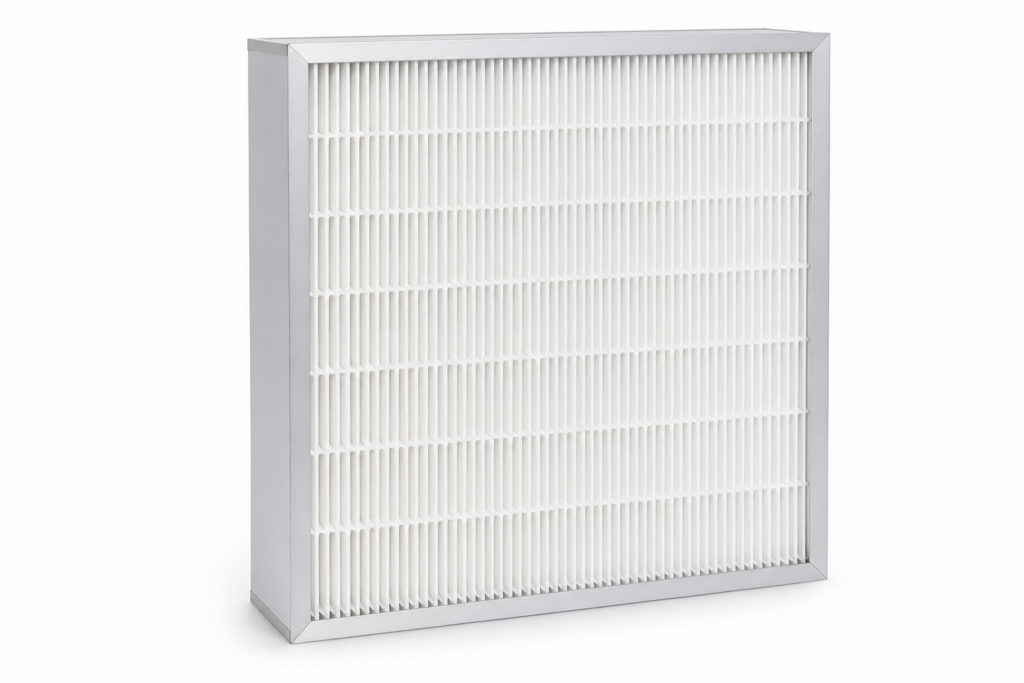
HEPA stands for High Efficiency Particulate Air. The number after it, 13, is a grade under the EN 1822 and ISO 29463 standards. These standards test filters by pushing particles through the media and measuring how many get caught.
Here’s how the grades compare:
| Grade | Efficiency at 0.3 micron | Common use |
|---|---|---|
| H10–H12 | 85% to 99.5% | General offices, retail HVAC |
| H13 | 99.95% | Hospitals, pharma cleanrooms, labs |
| H14 | 99.995% | ICUs, biosafety cabinets, critical cleanrooms |
A filter can only be called H13 if it’s been tested and rated at that level. A filter that just says “HEPA” on the box, with no grade and no test report, could be H10 or lower. The US EPA’s own definition of a HEPA filter makes the same point: the term only means something when it’s backed by actual testing, not just a label.
How is HEPA 13 different from HEPA 14 or a standard filter?
The gap between H13 and H14 looks small on paper, 99.95% versus 99.995%, but it changes where each one gets used.
H13 handles most controlled environments: pharma production floors, hospital wards, food processing lines. H14 gets reserved for spaces where even a small particle count matters, such as ICUs and biosafety labs handling infectious material.
A standard pre-filter or panel filter, by comparison, mostly stops dust and larger debris. It doesn’t touch fine particulates, bacteria, or most viruses. That’s why pre-filters sit upstream of a HEPA stage in an AHU. They catch the big stuff first so the HEPA filter lasts longer. Browse our pre-filter range to see washable and disposable options built for this exact stage.
Both grades sit under the ISO 29463 standard, which is the international classification most manufacturers test against alongside the older EN 1822 standard it’s derived from.
Where is HEPA 13 filter used?
HEPA 13 filters show up wherever air quality is tied to health outcomes or product safety:
- Hospital operation theatres and ICUs. Surgical sites need particle counts low enough to prevent airborne infection during procedures.
- Pharmaceutical cleanrooms and sterile production lines. Drug manufacturing gets audited against strict air cleanliness classes, and a failed HEPA test can halt a production line.
- Research and diagnostic labs. Biosafety cabinets rely on HEPA filtration to contain airborne samples and protect staff.
- Food processing plants with contamination controls. Packaged food lines use HEPA-filtered air to cut microbial contamination risk.
- Data centers and precision manufacturing units. Dust particles smaller than what a standard filter catches can damage sensitive electronics over time.
- Automotive OEM paint booths. Even microscopic dust causes visible defects in a painted finish, so paint booths run HEPA-filtered supply air.
- Commercial HVAC systems in large buildings. Offices, malls, and institutional buildings use HEPA stages where indoor air quality standards apply.
Each of these has different housing sizes and airflow needs, which is why custom sizing matters more than most buyers expect. A filter built for a 24-inch duct won’t perform the same way forced into an 18-inch housing with foam packed around the edges to make it fit.
HEPA filter manufacturing process
A properly made HEPA 13 filter goes through several checked stages, not just one pass through a machine:
- Media selection. Glass microfiber or synthetic media rated to hit H13 efficiency before any pleating starts.
- Pleating. The media gets folded into mini-pleat or box-pleat form. More folds mean more surface area, which means the filter can run longer before it clogs.
- Frame assembly. Aluminum, MDF, or galvanized steel frames get built around the pleated media, depending on the environment and moisture exposure.
- Sealing. Polyurethane or hot-melt sealant closes any gap between the media and frame. A poor seal lets air bypass the filter entirely, which defeats the purpose regardless of the media’s rating.
- Testing. DOP or PAO scan testing checks actual efficiency before the filter ships. This is the step that confirms a filter really performs at 99.95%, not just on the label.
- Documentation. Batch test records and ISO-compliant paperwork go out with the order, so the buyer has proof on file for compliance audits.
Ask any manufacturer to walk you through these steps. If they can’t explain step 5, the testing, that’s worth noticing. Our HEPA filter product range covers mini-pleat and box-type construction built to this exact process.
HEPA 13 filter price in India
Price depends on a few concrete factors, not a flat number:
- Size. Custom housing dimensions cost more to produce than standard sizes already in production.
- Media type. Mini-pleat construction generally costs more than basic box-type, but lasts longer in high-airflow settings.
- Order quantity. Orders of 50 units or more usually qualify for slab-wise discounts.
- Grade. H14 media costs more than H13 due to denser filtration material.
- Direct-from-factory vs. distributor. Buying direct removes a reseller’s margin, which is often 15% to 30% of the final price.
A quick note on “cheapest HEPA 13 filter” listings you’ll find online: a genuinely H13-rated filter has a real cost floor, set by the media and testing required to earn that rating. If a price looks far below the market range, ask for the test report before ordering. A legitimate H13 filter always comes with one.
Can you buy HEPA 13 filters online in India?
Yes, though it works a bit differently than ordering an off-the-shelf product. Most filters are made to order based on housing size, so the “online” part is usually the enquiry and quotation step, not a checkout button.
To get an accurate quote fast, share:
- Exact housing or duct dimensions
- Required grade, H13 or H14
- Quantity needed
- Application, hospital, pharma, HVAC, or lab
Manufacturers that respond with a real quote based on your numbers, rather than a generic price list, are usually the ones set up to handle custom orders properly.
Choosing a HEPA 13 filter manufacturer in India
Search results for “top 10 HEPA filter manufacturers in India” turn up different rankings depending on the source, so treat those lists as a starting point, not a final answer. What matters more is checking these five things directly:
- Test reports. Ask for EN 1822 test documentation, not just a certificate claim on the website.
- Manufacturing location. A factory-direct setup, especially one you can visit or call, usually means faster turnaround than a trading company reselling someone else’s stock.
- MOQ. Some manufacturers require bulk orders only. Others accept 10 units, which matters if you’re a smaller hospital or contractor.
- Custom sizing. Send a CAD drawing or sample and see if they confirm they can match it exactly.
- Dispatch time. 3 to 5 working days is a reasonable standard for domestic orders; anything much longer suggests a queue or outsourced production.
On the question of whether Indian HEPA filter manufacturers are listed on the stock market: most aren’t. Filtration is usually one product line inside a larger industrial or HVAC company, not a standalone listed business. Years in operation, client count, and certification records are more useful signals of stability than stock listing status.
How long does a HEPA 13 filter last?
Most HEPA 13 filters run for 6 to 12 months before replacement, but the real number depends on three things: airflow volume, particle load in the environment, and whether a pre-filter is installed upstream.
A pharma cleanroom running filtered air 24 hours a day will load a filter faster than an office HVAC system running 10 hours on weekdays. A pre-filter catches the larger dust and debris before it reaches the HEPA stage, which can stretch replacement intervals significantly since the HEPA media isn’t doing double duty.
Pressure drop is the number to watch. Every HEPA filter has a rated initial pressure drop and a maximum pressure drop before it needs changing. Facilities running continuous monitoring can track this directly. Without a gauge, a rough replacement schedule based on usage hours is the next best option.
Skipping replacement past the rated pressure drop doesn’t just reduce airflow. It also risks micro-tears in the media from the strain, which can drop actual filtration efficiency well below the H13 rating even though the filter still looks intact.
Frequently asked questions
Is a HEPA 13 filter washable?
No. The dense microfiber media isn’t built for washing, and water damages the pleats permanently. Pre-filters upstream of the HEPA stage are sometimes washable and exist specifically to extend the HEPA filter’s working life.
What’s the difference between HEPA 13 and HEPA 14?
H13 filters 99.95% of particles at 0.3 microns. H14 filters 99.995%. The gap looks small but decides whether a filter is suited to a general cleanroom or a high-risk space like an ICU.
What is the minimum order quantity for HEPA 13 filters?
This varies by manufacturer. Some require bulk orders of 50 units or more; others accept as few as 10, which works better for smaller facilities.
How long does delivery take?
Standard sizes typically dispatch in 3 to 5 working days. Custom sizes can take longer depending on the manufacturer’s current order volume.
How do I know a HEPA 13 filter is genuine?
Ask for the EN 1822 or ISO 29463 test report before ordering. A real H13-rated filter will always have one on file.
Annual maintenance contracts
Facilities that run HEPA filtration year-round, hospitals and pharma units especially, often set up an AMC instead of ordering replacements one at a time.
An AMC typically covers scheduled filter replacement, pressure drop checks, and testing documentation on a fixed calendar rather than waiting for a filter to fail. For compliance-heavy industries, this matters at audit time: an inspector asking for filter change records gets a clean log instead of a scramble to reconstruct dates from memory.
It also removes a planning problem. Instead of tracking replacement dates across dozens of AHUs manually, the manufacturer handles the schedule and flags when a unit is due.
Getting a quote
If you need a HEPA 13 filter for a hospital, pharma line, lab, or HVAC system, the fastest way to get an accurate price is to share your housing dimensions and required quantity directly. A manufacturer working from your real numbers can send a slab-wise price list within minutes, instead of a generic estimate that changes once the actual specs come in.
Reach us directly through our contact page, or send your requirement on WhatsApp for a same-day quote. For more filtration guides like this one, visit our blog.
Get a quote on WhatsApp