Table of Contents
ToggleBest Air Conditioner HEPA Filter | 10+ Yrs Manufacturer
Written by Neeraj Goel, Founder, 10+ years of experience manufacturing HVAC and industrial air filters in Delhi.
A normal AC filter catches dust. It does not catch the fine particles that trigger allergies, asthma, and respiratory irritation. An air conditioner HEPA filter does. This guide covers what a HEPA filter actually is, which type fits your AC, how much it costs in India, and when to replace it, based on what we’ve learned manufacturing these filters at hepafilter.in.
What is a HEPA filter
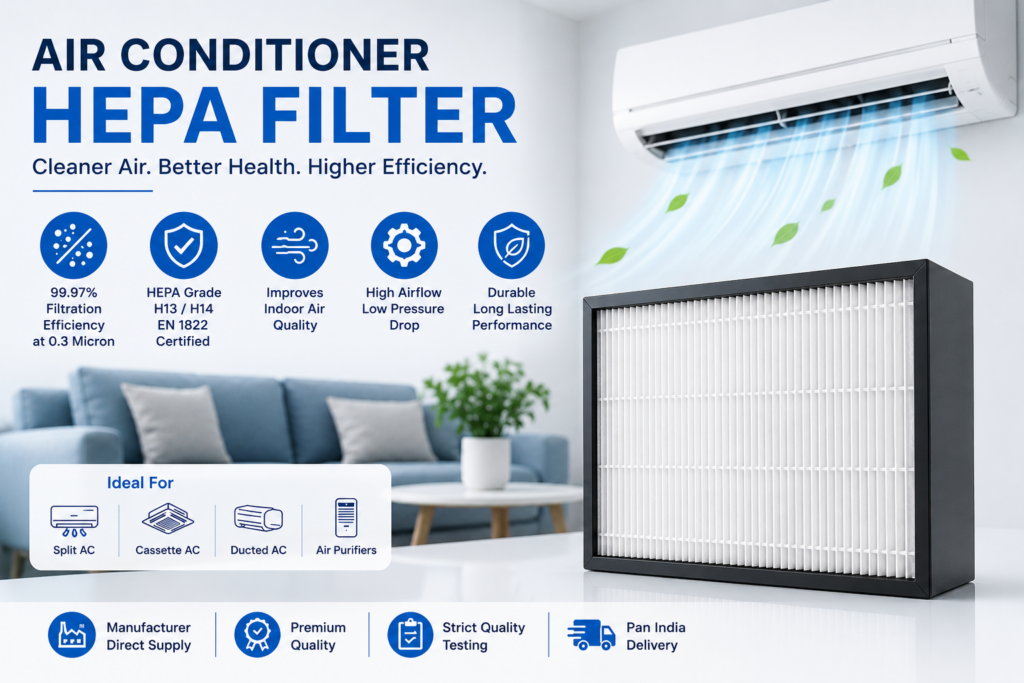
HEPA stands for High Efficiency Particulate Air. A true air conditioner HEPA filter traps 99.97% of particles down to 0.3 microns in size. That includes dust, pollen, mold spores, bacteria, and fine pollution particles that a standard filter lets straight through.
Certified HEPA filters carry an H13 or H14 rating. These ratings come from independent testing standards, not marketing copy. If a product says “HEPA” but shows no H13/H14 certification, treat that claim with caution.
Why your AC needs a HEPA filter
Standard AC filters are built to protect the compressor from large debris. They are not designed to clean the air you breathe.
An air conditioner HEPA filter changes that. It removes fine dust and airborne pollutants before they circulate through the room. For households with asthma, allergies, or young children, this makes a measurable difference in air quality. For offices and clinics, it supports a cleaner working environment day to day.
There is also a practical side benefit. A clean filter keeps airflow steady, which reduces strain on the compressor and can extend the life of the AC unit itself.
Indian cities add another layer to this. Several cities regularly report PM2.5 levels well above the limits in the WHO global air quality guidelines, especially in winter months, a pattern visible on the CPCB’s National Air Quality Index through most of the year. Since PM2.5 particles fall in the 2.5 micron range and below, a standard AC filter has no real chance of stopping them. An air conditioner HEPA filter, rated for particles as small as 0.3 microns, is built for exactly this range.
Who actually needs this
Not every AC needs a HEPA upgrade, but some settings depend on it:
- Hospitals and clinics, where airborne bacteria control is part of infection prevention, not an optional extra.
- Pharmaceutical units, where cleanroom standards require certified filtration at every stage.
- Homes with allergy or asthma sufferers, where fine dust is a direct trigger.
- Offices in high-pollution cities, where employee comfort and sick days are tied to indoor air quality.
- Manufacturing plants and labs, where dust control protects both people and equipment.
If your AC is in one of these categories, a HEPA upgrade is worth the cost. For a small apartment in a low-pollution area, a well-maintained standard filter may be enough, though the health benefit still favors HEPA where budget allows. Our full range of air filters covers all five of these settings.
Best air conditioner HEPA filter: what to actually check
Search results for “best air conditioner HEPA filter” are full of products that use the word HEPA loosely. Here is what separates a genuine air conditioner HEPA filter from a marketing label:
H13 or H14 certification. This is the baseline. Without it, the 99.97% claim is unverified.
ISO certified manufacturing. Consistent quality control matters more than a single good batch.
Correct size and fit. A filter that does not seal properly against the housing lets unfiltered air bypass it entirely. Fit matters as much as filtration rating.
A stated efficiency number. Look for 99.97% at 0.3 micron specifically, not a vague “removes 99% of particles” claim.
Support after the sale. Sizing help, replacement guidance, and maintenance contracts indicate a manufacturer that expects to have a long-term relationship with the buyer, not just a one-time sale.
Types of HEPA filters for AC systems
Different AC setups need different filter formats.
Mini-pleat and box-type HEPA filters. Used in cleanrooms, hospital operation theatres, and pharmaceutical HVAC systems, where filtration standards are strict and consistent airflow across a larger surface area is required.
Split AC HEPA filters. Sized for home and office split units, these fit inside the existing filter slot with a HEPA-grade cut.
Window AC HEPA filter. Window units have tighter housings, so these filters need precise cutting rather than a generic size.
Bag filters and pre-filters. Used ahead of the HEPA stage in AHUs, these catch larger debris first and extend the life of the main filter.
Custom and OEM HEPA filters. Built from a CAD drawing or a physical sample when standard sizes do not match the housing.
If you are not sure which category applies to your unit, share your AC model or a photo of the current filter with a manufacturer that offers custom cutting. That removes the guesswork.
HEPA filter vs normal AC filter
| Feature | Normal AC filter | HEPA filter |
|---|---|---|
| Smallest particle trapped | 10 microns and above | 0.3 microns |
| Filtration efficiency | 50 to 60% | 99.97% |
| Allergy and asthma relief | Limited | Significant |
| Certification | Usually none | H13 or H14 |
| Typical lifespan | Shorter | Longer, with correct maintenance |
The gap in particle size is the real story here. A normal filter blocks visible dust. A HEPA filter blocks what you cannot see, which is usually what causes the reaction.
Air conditioner HEPA filter size: how to choose correctly
Size is where most filter purchases go wrong. A filter that is close enough in dimensions will not seal against the AC housing, and unfiltered air leaks around the edges.
Three ways to get the size right:
- Measure the existing filter or the housing opening directly.
- Send a photo of the current filter along with its dimensions.
- Provide a CAD drawing if you need an exact custom cut, which is common for window AC units and older split systems.
A manufacturer that accepts all three options is generally easier to work with than one that only stocks fixed sizes.
Air conditioner HEPA filter price in India
Price depends on four factors: filter type, size, certification grade, and order quantity.
Buying factory-direct removes the trading margin and reseller markup that push up retail prices. This matters more on bulk orders, where a 10 to 15% markup per unit adds up quickly across 50 or 100 units.
Bulk pricing typically improves at the 50-unit mark, since manufacturing cost per unit drops with larger production runs. If you are ordering for a hospital, factory, or multiple HVAC units, ask for a slab-wise price list rather than a flat quote. This shows you the exact break points where price per unit drops.
For an exact number, share your filter type, size, and quantity directly with a manufacturer. Generic online prices rarely match what you actually pay once size and certification are factored in.
Here is a rough example of how the math works. A retailer buying through two middlemen might pay 30 to 40% more per unit than a hospital ordering the same filter directly from the factory, purely from stacked margins. On a 100-unit order, that difference alone can fund the next quarter’s replacement cycle.
Installing a HEPA filter: what changes in your AC
Fitting a HEPA filter is not a full AC redesign. In most split and window units, it replaces the existing filter slot, provided the size is correct. The main technical difference is airflow resistance: HEPA media is denser than a standard mesh filter, so a poorly matched fan motor can show a slight drop in airflow.
For most residential and office units, this is not noticeable. For older AC systems or units already running near their airflow limit, it’s worth checking the motor specification before switching, or asking the manufacturer whether a lower-resistance HEPA grade fits better.
When to replace your HEPA filter
Replacement timing depends on usage and environment, not a fixed calendar date.
High-pollution areas or heavy daily use: check every 3 to 4 months. Standard home or office use: 6 months is a reasonable interval. Commercial and industrial settings: follow the manufacturer’s AMC (Annual Maintenance Contract) schedule, since these environments load the filter faster.
Signs your filter needs replacing regardless of the calendar:
- Visible discoloration or heavy dust buildup
- Noticeably weaker airflow from the AC
- A musty or stale smell when the AC runs
- Damage to the filter edges or seal
An AMC removes the guesswork. Instead of tracking replacement dates yourself, the manufacturer schedules it for you, which matters for hospitals and factories that cannot afford inconsistent air quality.
Simple maintenance that extends filter life
A HEPA filter is not maintenance-free, even though it lasts longer than a standard one.
- Keep the AC’s outer vents clear. Blocked vents force more air through the filter at once, which loads it faster than normal use.
- Avoid vacuuming or washing a true HEPA filter unless the manufacturer specifically says it’s washable. Standard HEPA media is not designed to survive water or vacuum suction without damage to the fibers.
- Log the install date. A simple note on the filter housing or in a maintenance sheet prevents guesswork later.
- Watch airflow, not just time. A drop in airflow is often a more reliable signal than the calendar, especially in high-dust environments.
- Pair with a pre-filter where possible. A washable pre-filter catches larger debris first, which extends the life of the HEPA stage behind it.
Why source and expertise matter here
Air quality information affects health decisions, so the source behind it matters. Google groups this under E-E-A-T: experience, expertise, authoritativeness, and trustworthiness. Their guidance on this, published under Creating helpful, reliable, people-first content, states plainly that trust is the most important of the four, and that content should come from real first-hand knowledge rather than recycled claims.
In practical terms, that means a HEPA filter guide is more useful when it comes from a manufacturer that actually tests, certifies, and cuts these filters, not from a site repeating generic specs found elsewhere. Ten years in filter manufacturing, an ISO certification, and direct handling of H13/H14 testing are the kind of first-hand experience Google’s guidance points to. You can read more about our background on the about us page.
Frequently asked questions
What is the minimum order quantity for HEPA filters? Most manufacturers set MOQ around 10 units per filter type, which lets smaller facilities order without holding excess stock.
Can I get a custom size or OEM filter? Yes. Send your housing dimensions, a CAD drawing, or an existing sample, and the filter gets cut to that exact specification, including private-label OEM orders.
How fast is dispatch and delivery? Standard orders typically dispatch within 3 to 5 working days, with delivery available across most of India through logistics partners.
Are these filters actually certified? Genuine HEPA filters carry H13 or H14 certification, tested to 99.97% efficiency at 0.3 microns, from an ISO certified facility.
Is an AMC worth it? For hospitals, pharma units, and factories that need consistent air quality, yes. It removes the risk of forgetting a replacement cycle.
What discount applies on bulk orders? Pricing typically improves at 50-plus units. Share your quantity directly for a slab-wise breakdown.
Will a HEPA filter reduce my AC’s cooling performance? A correctly sized HEPA filter, matched to your AC’s fan capacity, has minimal impact on cooling. Performance issues usually come from an incorrect size or an overloaded filter that’s overdue for replacement, not the HEPA rating itself.
Can I use the same HEPA filter for a window AC and a split AC? No. Window AC units have a tighter, shallower housing, so they need a filter cut to that specific shape. Using a split AC filter in a window unit usually means a poor seal and reduced filtration.
Need a HEPA filter that actually fits your AC?
Ten years of manufacturing experience, H13/H14 certified filters, and over 1,100 clients across India back this recommendation: buy factory-direct, confirm the certification, and get the size right before you order. Visit hepafilter.in for our full product range and pricing.
Share your AC model, size, and quantity over WhatsApp for a free quote: Get a quote